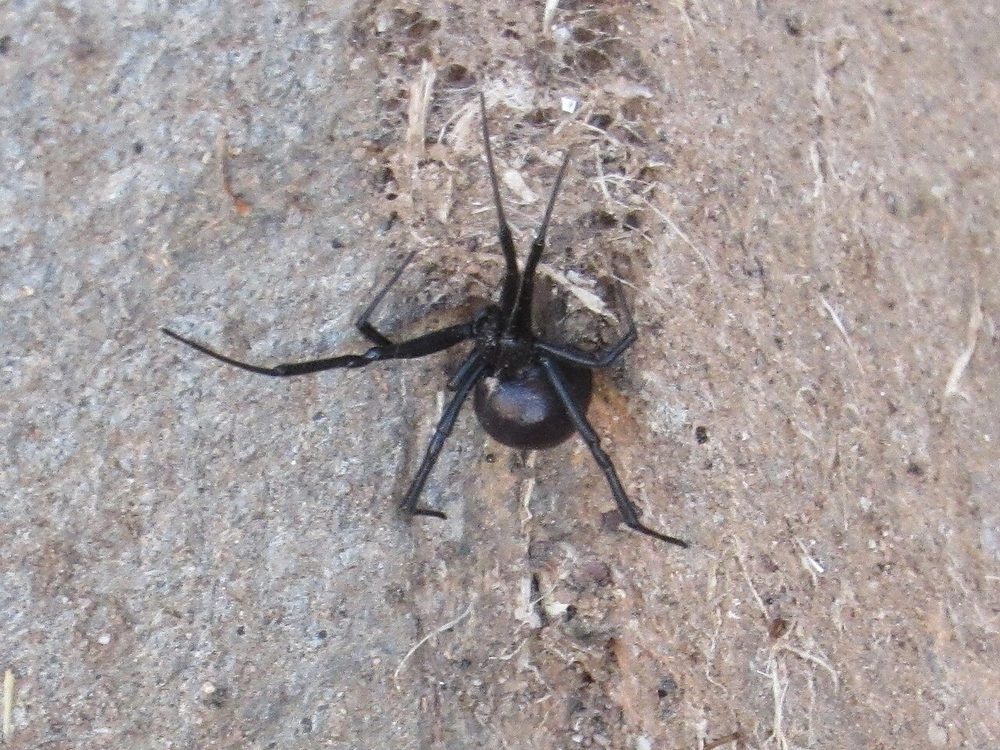
How do you identify a spider you just found indoors?
Start with two things: whether it was sitting in a web or moving across a surface, and where you found it. Web-builders sit in or near their webs in undisturbed corners; roaming hunters like wolf and huntsman spiders are usually found crossing a floor or wall with no web at all.
Body proportions come next. A widow has a rounded, glossy, bulbous abdomen and thin legs; a recluse has a small flat body with long thin legs and a uniform tan color; a wolf spider is stout and hairy with a robust body; a cellar spider has a tiny body on extremely long thread-like legs. Most identification questions are settled by web behavior plus proportion rather than fine markings.
Compare spider profiles
How can I tell a brown widow from a black widow?
Both are widows with an hourglass marking on the underside of the abdomen. The southern black widow is glossy black with a bright red hourglass; the brown widow is tan to brown with mottled markings and an orange to yellowish hourglass.
The egg sac is another useful clue when you can see one safely: brown widow egg sacs are covered in distinct spiky projections, while southern black widow sacs are smooth. Both build irregular, tangled webs in protected spots rather than neat orb webs, and both are shy and retreat when disturbed. Neither should be handled.
- Southern black widow — glossy black body, bright red hourglass underneath, smooth egg sac
- Brown widow — tan to brown, mottled pattern, orange to yellowish hourglass, spiky egg sac
- Both — irregular tangled webs in sheltered locations; retreat rather than confront
Where are widow spiders usually found?
In protected, undisturbed spaces close to the ground or under objects: garages, sheds, crawl spaces, under outdoor furniture and grills, in meter boxes, under stored lumber, in landscape stone and along foundation lines.
This is why gloves matter when moving stored items, reaching into a dark shelf or handling firewood and yard materials. Brown widows in particular are often found in the undersides of outdoor furniture, planters, mailbox undersides and similar sheltered spots.
Southern black widow profile
What does a brown recluse look like, and is misidentification common?
A brown recluse is small and uniformly tan to light brown with a darker violin-shaped marking on the front body section and long, thin, unbanded legs. Misidentification is extremely common — most brown spiders reported as recluses turn out to be something else.
Ordinary house spiders, sac spiders, funnel weavers, cellar spiders and juvenile wolf spiders are all mistaken for recluses. The violin marking is not reliable at a glance in a photo, and eye arrangement, which experts use, is not visible without magnification. If identification matters, a clear photo or a safely collected specimen is far more useful than a description.
Brown recluse profile
Is a wolf spider dangerous?
Wolf spiders are hunters that do not build webs and are frequently found crossing floors, garages and patios. They are startling because of their size and speed rather than because they are aggressive.
They are stout, hairy and brown to gray with mottled patterning, and females may carry an egg sac attached to the abdomen or young on their back — which is often what people notice. Huntsman spiders, sometimes called giant crab spiders, are also large, flat and fast, with legs held crab-like to the sides, and are commonly found on walls in garages and outbuildings. Both are roaming hunters rather than web-builders.
What about the long-legged spider in the basement corner?
That is typically a cellar spider — a tiny body suspended on extremely long, thin legs, sitting in a loose, irregular web in a ceiling corner, crawl space, garage or basement.
Cellar spiders are harmless to people and are sometimes mistakenly called "daddy longlegs," a name also applied to harvestmen, which are not spiders at all. Persistent cellar spider webs in a garage or crawl space usually indicate a steady supply of small insects, so reducing insect pressure and moisture in that space tends to reduce the spiders.
Can a spider bite be identified from a skin lesion?
No. A wound cannot establish that a spider caused it, and many conditions — including bacterial skin infections — are commonly mistaken for spider bites.
Medical evaluation of a concerning wound should come from a healthcare provider, not from pest control, and we do not diagnose bites. If a spider was actually observed biting, and it can be collected or photographed safely, that information may help a clinician. Bites from medically significant spiders such as widows and recluses do occur but are uncommon, and both species are shy and retreat rather than confront.
Do not handle a spider to identify it. A photograph taken from a safe distance, or a specimen captured under a jar without touching it, is enough.
How do you reduce spider activity around a home?
Spiders follow their prey, so reducing insects and removing sheltered harborage does more than treating spiders alone.
- Knock down webs regularly around eaves, entries, porches and window frames
- Reduce exterior insect attraction near doors, including bright lighting aimed at entries
- Keep garages and sheds organized, using hard totes instead of cardboard
- Wear gloves when moving stored lumber, firewood, planters and outdoor furniture
- Shake out shoes, gloves and stored clothing left in a garage or crawl space
- Pull leaf litter, stone piles and debris back from the foundation
- Seal gaps at doors, windows and utility penetrations
Spider control
When should you get professional help with spiders?
When widow or recluse spiders are found in living or working areas, when webs and sightings keep returning after cleanup, or when spiders are appearing in areas used by children or pets.
Repeat activity usually means there is a steady insect supply and suitable harborage nearby. We provide spider service across Baldwin County and the Gulf Coast, with one-time and recurring options, no long-term contract required, and a 30-day warranty on applicable services and issues.